Showing posts with label textiles. Show all posts

September 24, 2013

Interwoven Globe at the Metropolitan Museum

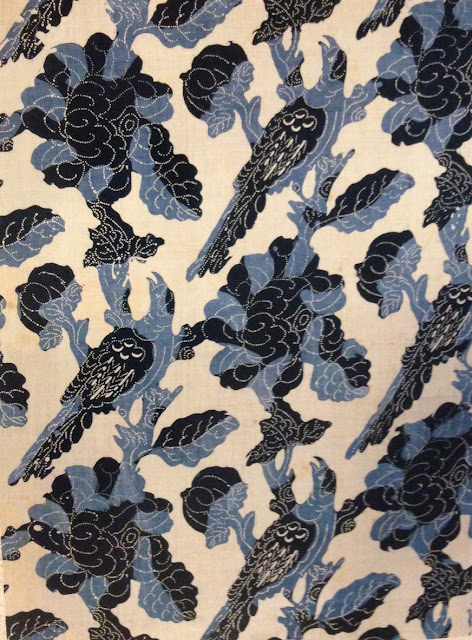
Blue Resist Panel- cotton fabric painted and block printed resist most likely made in India for the American market


There is a new exhibit at the Met that I had to see and was going to get there no matter what....which means Harper, my new baby, was most likely coming with me.  So last week I packed up the stroller, brought the carrier in case the stroller wouldn't be allowed and Harper and I headed to the number 4 train at Barclay's Center up to 86th St stop in Manhattan.  I wanted to blog about this exhibit because I know many of us are so busy and may not know what is current at the museums.  And with so much in NYC the options are endless.

Interwoven Globe are fabrics from wall hangings to clothing made in between the 14th and 18th centuries.  This is when exploration was at it's peak.  Most of the fabric was made in India or China for Europe or America markets.  Unlike today's global markets, these items were mainly made for and sold to the wealthy.  There were wall hangings, carpets, decorative textiles, bed covers and waistcoats.  Most of the thread used was silk or metal wrapped thread.

Palampore - from India made for the Sri Lankan market
cotton, paint resist and mordant, dyed 72" x 44"
The above piece is called a palampore which was usually a bed cover drawn or painted then dyed.  What I found amazing is that this type of design you will see in Pottery Barn or Macys.  It is a very common design for sheets and duvet covers.  Things haven't changed much! However this piece would be purchased by only the wealthiest families.

double sided wall hanging from China made for the European market in the second half of
the 18th century.  This is silk satin and embroidered with silk.

The above double sided wall hanging was most likely used in a window so art can be seen from the outside and on the inside.  This also may have been a substitute for wall paper since it couldn't be produced fast enough for the European market.

By the second half of the 18th century India products were being largely influenced by the west.  This was reflected mostly by color and slightly by design.  Chintz became popular in the Netherlands being made in India or China.

A few more pieces that caught my eye.

Fustian with pheasants and exotic flowers. The art is a European interpretation of foreign motifs.
Fustian is fabric that is cotton in the warp and linen in the weft
This was copperplate printed which became popular in the second half of the 18th century

over 7 feet long - from India made for the Japanese market in the 18th century
cotton and paint resist, then dyed
Sarasa with small rosettes

If you are looking for a few hours of inspiration definitely try to make a trip to the museum.  And if you have a baby, strollers are allowed (not the double wide ones) and Harper seemed to enjoy looking at all the colors of the fabrics.

Have a great week!
Tracey

http://traceytoole.blogspot.com/
https://www.etsy.com/shop/traceytoole

June 8, 2008

Crafty Inspiration in India

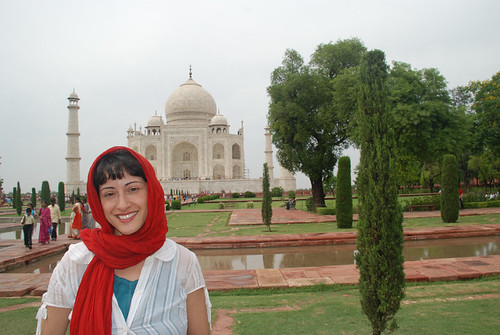
I just got back from a whirlwind 10 days in Northern India - Delhi and Agra. Here's me at the Taj Mahal in Agra. It was truly spectacular. Beyond the wonderful sights and food, I got to explore the strong craft tradition that India has, it was truly inspiring.

One of my most memorable days was spent at the Craft Museum in Delhi, wandering through its galleries to see its wide range of metal work, sewing, pottery and painting. Though this museum was actually set up by the British during their ... ahem ... stay, it covered a wide range of India's crafts. Below is a photo of a small piece of a wall full of paintings that narrated the Ramayana. I usually imagined the famous miniature paintings of India when I thought of it's painting tradition so this was a departure from that. This was an extremely large appliqué that hung on the ceiling of the main gallery. I loved the patterns on it - very beautiful. All of the textiles that we saw during our stay were beautifully patterned in bright eye catching colors with many floral motifs like this one on the appliqué.

There was such a focus on decorative elements and details in everything, from textiles to wood carving, embroidery, masonry (see above photo of the semi-precious stone work inlay on the Taj Mahal) to even your body! Their wonderful tradition of mehndi is a henna dye technique that is applied to you hands and feet. The tradition began as a decorative ritual for weddings, but has spread to be more widely used for other celebrations as well.

I can feel the wheels on inspiration going already!
So much pattern and decoration, really inspiring, i see paisley inspired tee shirts in my future with bold colors and an emphasis on natural forms.

I found some of these items from the {NewNew} using the techniques I saw in India; applique and embroidery with rich colors and floral patterns.


-Kimm
KimmChi.etsy.com

February 29, 2008

Friday Night Beauty Tip


Beauty, it is said is "in the eye of the beholder". Living in a culture and working in the fashion industry where external beauty can become an obsession I was pleased to find an anti-fashion designer. “Ma Ke, a chinese designer, abhors assembly lines. The trademark of her majestic line is based on burying the clothes in dirt to allow nature and time to put the finishing touches on her work.” There is a movie debuting at the Toronto film festival about the contrast between mass produced and her garments entitled ‘Useless’. I found her through a short clip on the selvedge website, she speaks about hand made objects containing emotions, emotions of the crafters. This was so poignant I wanted to share, beauty is not only the external of the objects we create but also the quality of our emotions while we create them.**selvedge, is a textile magazine focusing on non traditional forms of textile. It also showcase unique crafters and crafts.